Beyond AIOps: Enabling ANL4 in Real Production Networks
For years, AIOps has been primarily associated with experimentation, advanced analytics, and proof-of-concept initiatives. However, as telecommunications networks continue to grow in scale, technological diversity, and operational criticality, that approach is no longer sufficient. The industry requires deterministic, governed, and repeatable operations, not just better insights.
From a broader perspective, Iquall Networks approaches complex problem solving in telecommunications based on a clear premise. Not trying to cover everything, but building solid solutions through an ecosystem of highly specialized partners. The complexity of modern networks is not addressed with monolithic platforms or generalist vendors, but by integrating deep capabilities, each one mastered within its own domain.
Within this model, Iquall assumes the role of specialist in Network Automation and Orchestration, focusing on execution, control, and governance of network processes at scale. On that foundation, it relies on partners with deep expertise in specific areas of the ecosystem such as AIOps, observability, performance, and analytics, bringing proven knowledge and best-in-class technology. This strategy of explicit specialization and pragmatic integration enables robust and sustainable solutions, regardless of network domain or operator maturity level.
This approach is reflected in the collaboration with VIAVI Solutions, a recognized leader in AIOps and advanced observability, where intelligence is not limited to event detection or visualization, but is integrated with an execution layer capable of operating in real production environments.
This was the central theme of the webinar AIOps builds scalable, AI driven network operations today, which showed how this way of working is already delivering tangible value in a commercial production network. The full webinar content is available here:
https://senzafili.com/aiops-builds-scalable-ai-driven-network-operations-today
The work presented, developed jointly by Iquall Networks, VIAVI Solutions, and Claro Colombia, and moderated by Senza Fili, demonstrates that Autonomous Networks Level 4 is not a future vision or a theoretical construct, but a concrete trajectory already underway in a real production environment.
AIOps as a key enabler, but not the only one, on the path to ANL4
CSPs today operate increasingly complex, multi-domain, and multi-vendor networks, with rising customer experience expectations, stricter SLAs, and sustained pressure on costs and specialized talent. In this context, traditional operating models are reaching structural limits that cannot be addressed solely with more monitoring or more analytics.
The lack of end-to-end visibility across network, services, and customers, combined with technical KPIs that fail to reflect real experience impact, leads to predominantly reactive operations. Problems are detected late, resolution relies heavily on human intervention, and MTTR increases as operational complexity grows. This situation not only affects operational efficiency, but directly blocks any serious progress toward higher levels of autonomy.
Within this context, AIOps emerges as a relevant capability to improve understanding of network behavior and anticipate degradations. However, on its own, it does not enable ANL4. Without an execution, control, and governance layer capable of turning intelligence into executable operational decisions, AIOps remains limited to insight, with no structural impact on the operating model.
MAT Suite as the execution and governance layer for ANL4
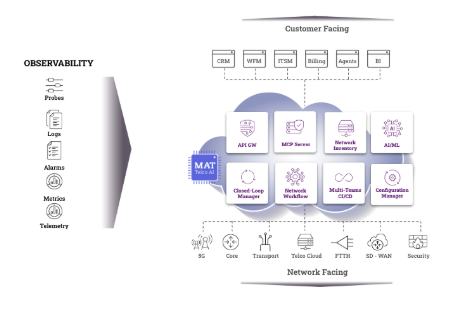
This is where the role of Iquall Networks and MAT Suite becomes central. In the case presented, MAT Suite acts as the execution layer that decouples observability, analytics, and operations, enabling signals generated by AIOps to be transformed into real operational actions, without rewriting OSS or BSS systems or introducing operational risk.
MAT Suite enables end-to-end orchestration and automation across multiple domains and vendors, always under clearly defined policies, network state control, and full traceability. It also introduces a telecom-oriented CI CD model that allows closed loops and automation flows to evolve in a controlled, auditable, and multi-team manner.
In addition, MAT Suite provides native integration with AI models and AIOps platforms, ensuring that intelligence does not remain isolated in the analytics layer, but is incorporated directly into executable operational decisions. This approach aligns with the CLADRA model and with the Autonomous Networks framework promoted by TM Forum.
In this way, MAT Suite is positioned not only as an automation platform, but as an operating framework for Autonomous Networks, specifically designed for complex, mission-critical telecom environments.
ANL4 in a production network: the Claro Colombia case
A central aspect of this work is that it is not a pilot or a lab environment. The AIOps and closed-loop automation capabilities presented are deployed on a commercial production network at Claro Colombia, carrying real traffic, supporting active SLAs, and serving real customers.
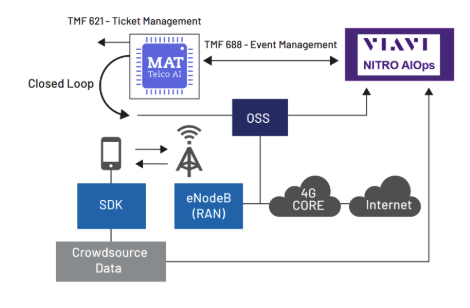
In this environment, the combination of advanced observability and governed execution enables degradation to be detected before customers perceive the impact, incidents to be prioritized based on actual service criticality, and corrective actions to be executed autonomously within clearly defined operational boundaries.
This behavior is consistent with ANL4. The system makes operational decisions autonomously under intent and policy, while human teams focus on governance, continuous optimization, and evolution of the operating model.
 Governance and operational impact as ANL4 enablers
One of the most relevant learnings from this case is that ANL4 does not imply loss of control, but rather explicit control by design. Autonomy in production networks does not come from delegating decisions without constraints, but from building a governance model that allows automated actions to be executed in a predictable, traceable, and safe manner.
In the production deployment at Claro Colombia, operational governance is the central enabler that allows AIOps and closed-loop automation to scale without introducing risk. Every automated action is executed within a clear framework of intent, policies, and network state control, with full traceability and auditability. The separation between intent, decision, and execution is what transforms automation into true autonomy.
This governance model has a direct operational impact. With execution under control, closed loops can operate continuously without constant human intervention. As a result, manual effort associated with monitoring, analysis, and incident escalation is significantly reduced. Root cause identification accelerates, reliance on human intervention decreases, and operations gain predictability and consistency, even as network complexity continues to grow.
Most importantly, these benefits are achieved without compromising stability or control, validating that autonomy can scale safely when an execution layer is specifically designed for critical telecom environments.
Conclusion
AIOps is no longer a future promise. When integrated within a governed execution model, it becomes a real enabler of Autonomous Networks in production. Achieving ANL4 today requires more than intelligence alone. It requires the ability to make platforms and vendors work together in a coherent way, transforming fragmented capabilities into operational outcomes.
Real progress comes from orchestrating specialized technologies across the ecosystem to deliver measurable results in the short term, while remaining fully aligned with a future-proof architecture. This approach avoids isolated optimizations and instead builds sustainable operational capabilities that can evolve as network complexity and autonomy requirements increase.
In this context, MAT Suite and the operational experience of Iquall Networks play a key role by enabling collaboration across platforms, governing execution end to end, and turning intelligence into predictable, scalable, and controlled outcomes.
The difference is not in the whats.
It is in how they are executed.